


CREDENTIALING
The integrity of the capital “C” Church is one that we must protect and defend at all cost. Our credentialing process is designed to do just that.
Three levels,
one calling…
We will walk alongside you as you go through the process of finding out what it means to carry the title of Pastor.
We’ll challenge you to think through parts of ministry you may have never experienced and help you see your blindspots.
Our credentialing is also an amazing process available to any of your staff or team that your church wants to ordain.
POSSIBLE: Credentials at Missionary Church grow with your ministry. Each level builds on the one before it — in coursework, in experience, and in responsibility.
Specialized
Need Info
-
Description text goes here
LICENSED
This identifies those whose ministerial calling and gifts have been formally recognized by Missionary Church leadership through the granting of a ministerial license, authorizing them for and appointing them to actual service in the ministry, subject to supervision and evaluation, as a step toward ordination.
-
The applicant shall be reviewed and recommended by the regional, district or network leadership. Applicants must have completed a minimum course of study consisting of:
Pastoral Orientation course of the Missionary Church
and at least one course in each of the following:
Old Testament
New Testament
Biblical or Systematic Theology
Practical Ministry Theology
Biblical Interpretation
Homiletics
Communication
ORDAINED
Ministers whose calling, gifts, and usefulness have been demonstrated and enhanced by proper training and experience, and who have been separated to the service of Christ by the regional, district or network leadership and by the solemn act of ordination and thus have been fully invested with all the functions of the Christian ministry.
-
Candidates for ordination shall fulfill the educational requirements listed below:
Completion of any bachelor’s degree in professional Christian ministries, or
Completion of any master’s degree in professional Christian ministries, or
Completion of the Pastoral Leadership Institute course of studies, or
Completion of a supervised course of studies including 32 semester hours of general education courses and 21 semester hours of professional Christian ministries courses, in addition to the minimum courses prescribed in the requirements for obtaining a license (Old Testament, New Testament, biblical or systematic theology, practical ministry theology, biblical interpretation, homiletics or communication, leadership and Pastor Orientation Course of the Missionary Church), with a minimum of three hours in each of the following: Old Testament, New Testament, biblical or systematic theology, counseling, evangelism and discipleship, and one course related to the individual’s area of ministry (youth, missions, Christian education, church planting, church growth, etc.).
WHAT ARE THE QUALIFICATIONS?
Ministers are men and women called of God to serve the church in an official leadership capacity who normally have special education for such a ministry, whose leadership roles are certified through licensure or ordination, and who receive financial remuneration for their services.
This includes ministers such as pastors, evangelists, Christian education or youth ministers, chaplains, or persons directly involved in the theological training of people for ministry.
Ministers must meet the following qualifications:
-
Spiritual Maturity and Christian character as evidenced by the fruit of the Spirit as given in Galatians 5:22-23 and by the qualities required for Christian leaders in 1 Timothy 3:1-7 and Titus 1:5-9.
Gifts of Leadership confirmed by the church of which they are members (Ephesians 4:11-14).
A Servant Spirit that enables them to submit to the authority of God as they lovingly exercise that authority in ministering to the people of God (John 13:1-17; 1 Cor. 4:1-2; Phil. 2:1-11).
-
A high school diploma or its equivalent.
Additional education as set forth in the description of licensed and ordained ministers.
Note: Special consideration may be given after consultation with the candidate; the regional, district, or network leadership; and the president or his representative.
-
Participation in and completion of a Pastoral Orientation course of the Missionary Church.
A commitment to hold and to teach the denominational “Articles of Faith and Practice.”
A commitment to support the programs of the Missionary Church.
A commitment to communicate by word and example a Christian worldview and lifestyle as reflected in the Missionary Church Constitution and Pastor Orientation Manual.
Membership in a local Missionary Church unless otherwise approved by the regional, district or network leadership due to extenuating circumstances.
All credentialed ministers are required to attend their regional, district or network conference when they meet unless there are extenuating circumstances that are reported to and approved by the leadership of that entity prior to conference.
It is the policy of the Missionary Church not to license or ordain a person who has been divorced, divorced and remarried, or married to a person who has been divorced. In cases where there are extenuating circumstances, application may be made to the regional, district or network leadership, and upon a 75% vote of that body, a recommendation may be sent to the General Board, which shall appoint a special commission to thoroughly investigate the case and give approval or disapproval.
Missionary Church Credential process

1. CHURCH MEMBERSHIP
Establish membership in a local Missionary Church
*Applicants living in an area where there is no Missionary Church must comply with steps 2 &3 in this list.

3. RECOMMENDATION
Receive an official recommendation from the board of your local church.

5. Interview with your regional leaders and credential committee
Join the Missionary Church in your area and counsel with your pastor. (If there’s no Missionary Church near you, begin with the regional, district, or network leaders.) Discuss your call to ministry with the regional leaders and receive an official recommendation from leaders at either your local church or region.

7. Complete background checks and pastoral orientation exam
Complete the Pastoral Orientation Exam and background checks.

2. CONTACT LEADERSHIP
Counsel with your pastor and regional, district or network leadership as to the nature and condition of your call from God to the ministry.

4. SUBMIT APPLICATION
Submit a completed Application for Ministerial License Part I for consideration by your regional, district or network leadership.

6. Submit Application part 2
Submit a completed Application for Ministerial License Part 2 for consideration by your regional, district or network leadership. Here’s a PDF to review and prepare
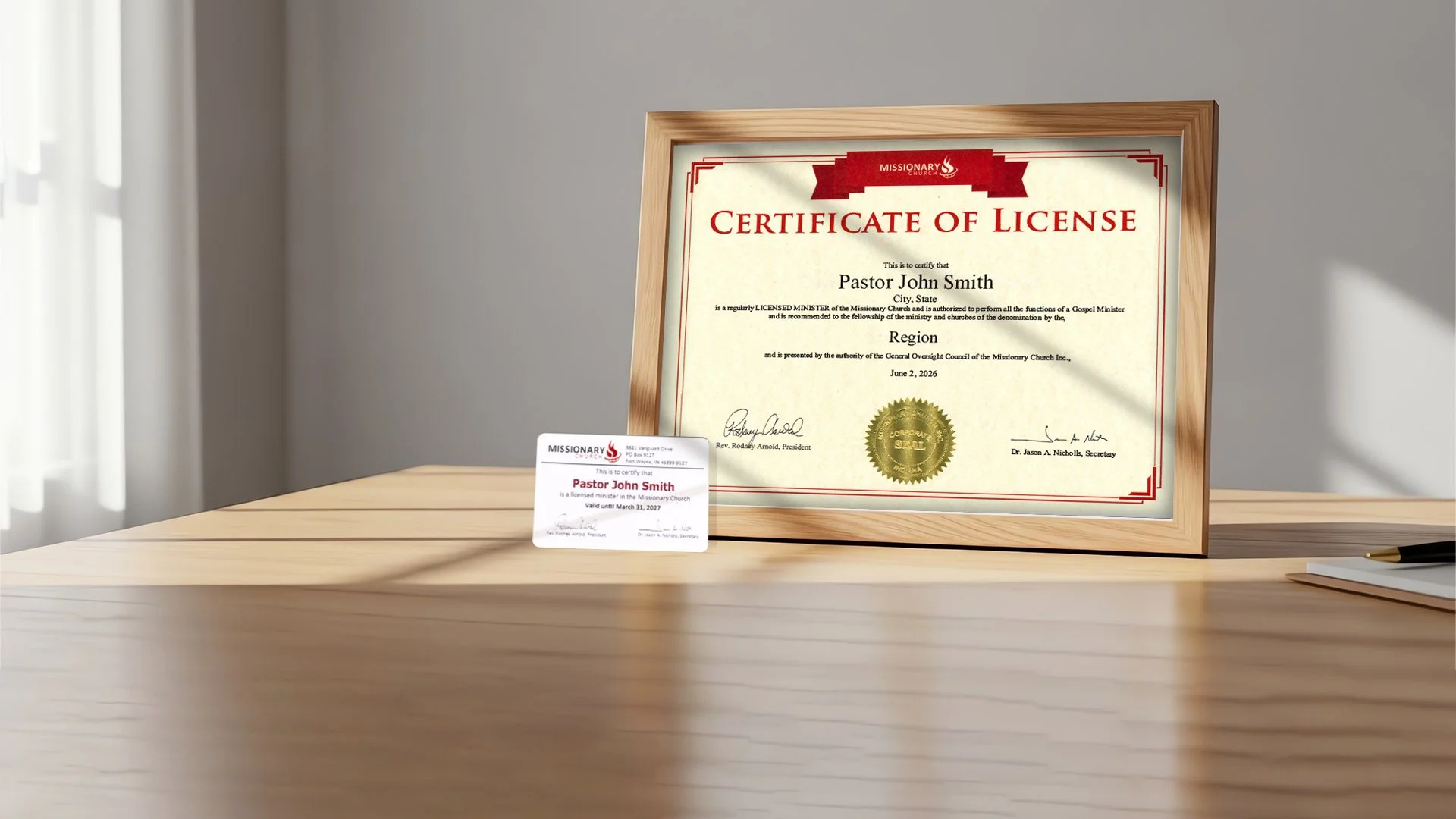
8. After approval by the regional board, credentials will be issued by the national office
Complete this application for Ministerial License Part 1
After this has been completed, your regional leaders will receive a copy.